
Learning to MOO

With all the excitement of the regular IRC discussions hosted by signposts, I thought I’d introduce everybody to another medium for instant conversation on the Internet: MOOing.

MOOs, or Multi-user Oject-Oriented, are best described as text-based virtual reality simulations. They are run on UNIX computers connected to the Internet; all one needs to participate is access to the ‘net and a telnet client.

Once newbies get used to them, MOOs are very easy to navigate in. Locations in a MOO, called rooms, usually have exits that correspond to the cardinal directions on a compass (“north,” “south,” “east,” “west,” etc.), as well as commonly-used monikers (like “out” to leave rooms like closets). You can talk to others in the room by typing say something or "something, which results in others seeing something like, CWhiz says, something. Objects as varied as TVs, helicopters, and parrots can (usually) be picked up, used, or given away as gifts. (There’s even a King James Bible, but the Gopher server that provided the text for the object seems to have been taken down.)

For geeks, a MOO is even more interesting because it’s possible to extend the virtual world by adding new objects and other commands (called verbs). For LambdaMOO, the most popular MOO and MOO server, all it takes is getting a programmer bit and learning a fairly simple, yet powerful, scripting language.

If you’d like to come visit my apartment on LambdaMOO, just let me know via my feedback form, and I’ll be happy to show you around. Or, if you’d like to explore on your own, just telnet to lambda.moo.mud.org, port 8888.
For the Graduate

Yesterday, I went to a high school graduation. In attendance were many of the people in my church small group, both soon-to-be graduates and well-wishers.

I’ve barely graduated from high school, but it has been a year longer than the graduates of the class of 2003. My thoughts, though woefully incomplete, may be of potential use to the new graduates. So, without further ado, here’s a list of suggestions to follow I’ve learned since I left from high school:

Continue reading

More Delays for SDIO Wi-Fi Cards

I’ve been anxiously awaiting the arrival of SDIO Wi-Fi cards. A Palm handheld is so much more useful when it can talk on the Internet. My handheld already has all the software I would need to be productive on the ‘net. All it needs is a way to get access.

When I learned that SyChip was testing reference implementations of a Wi-Fi card, I was thrilled. The card, slightly larger than a postage stamp, would plug into the top of my m515 (and most newer handhelds) and let me connect via my Linksys wireless access point. Once connected, I could surf the web with AvantGo, HotSync, check my e-mail with Eudora, and even control my notebook computer anywhere in the house with PalmVNC.

Sounds exciting, doesn’t it? Well, the bad news is that SyChip’s first major reseller, SanDisk, has been pushing the release date back ever since the initial announcement, from the second quarter of 2003, to June, and now to July, with Palm OS drivers available in Fall.

I suppose I should be optimistic, seeing that the latest announcement is the first mention of the card that SanDisk has made on its web site.

Fitting In

One of the first things I worked on when I started this blog was try to decide which category I fit into at blogs4God. I went to all eight categories, read the cute little definitions on the top, surfed a few of the inhabitants of each category, and decided that I don’t fit neatly into any of them.

Too often, we tend to take a person and try to stuff them into a category they may not necessarily fit into. This unconscious profiling can hurt others (look what it’s done to airports in the U.S.), but I think many people still engage in gossip, finger-pointing, etc. It’s so easy to give somebody a title and then try to assign them to their place in the social hierarchy.

I don’t think God is very happy about this. The Bible makes it clear that God is love, and slicing a person away based on a stereotype of where they “fit” doesn’t seem to be a very loving thing to do.

Something to think about the next time you’re sizing up somebody in your mind. (I know, because I do it all the time.)

P. S. Seeing that I needed a category, I chose techBlogs because I have a feeling I’m going to go geeky from time to time, and if I chose anywhere else I might intimidate the casual reader. This way, people have some advanced warning.

Another Enlightened School

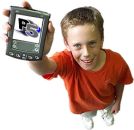
Kid holding a Palm handheld displaying the Planet 5th logoLast Saturday, I wrote about how the University of South Dakota is distributing Palm handhelds to every member of the student population. I think people can get their minds around how incredible it is for college students to be using these, but how about fifth graders?

Tony Vincent, a teacher at Willowdale Elementary School of Omaha, Nebraska, is using handhelds in every subject he teaches – math, spelling, science, social studies, and more. Each student is issued their own personal handheld, which they use to read virtual handouts and web sites, write papers and interactive fiction, and figure out strategies to solve puzzle games.

The best part about the Learning in Hand curriculum for open-source geeks like myself is that not only are the techniques he uses well documented on his site, but also that most of the programs installed in the handhelds are free for the download. Teachers, pay attention – this could be your classroom!

While it might be fun to play with PDAs all day long in school, Vincent is quick to point out that while the Palm is often the best learning tool, “other times it’s good, old fashioned paper!”

Planet 5th‘s web site is on hiatus for the summer, but you can read the pages from the 2002-2003 school year by clicking here.

(Photo courtesy Tony Vincent.)

UPDATE 5/27 8:42 PM – Bene Diction points out via comment that fellow blogger Christopher Wright is also doing this with his third graders. Incredible.